
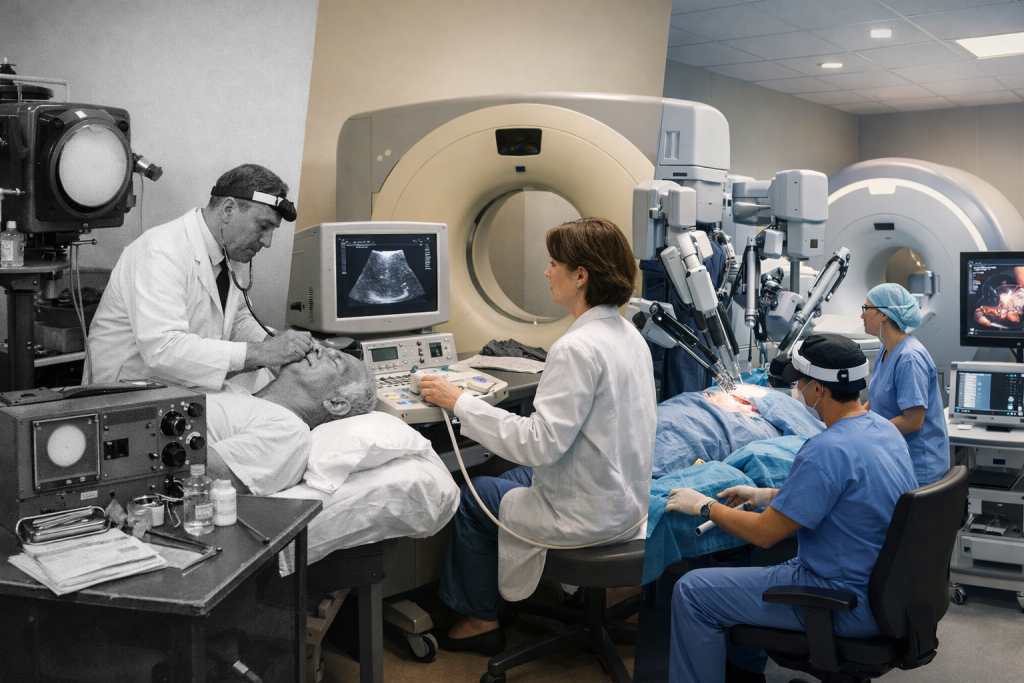
Innovative technology has changed how medical practices are conducted and health issues resolved. Over the years, as technology has continued to evolve, it has also modernized healthcare greatly. These advancements have improved patient recovery, enabled higher levels of accuracy when it comes to diagnoses and enabled more effective treatment methods.
It all began with the innovation of simple medical tools and equipment in the 20th century. It saw rapid advancements in medical technology, driven by scientific discoveries and the development of new technologies. There was a shift from the use of harsh instruments like large knives for surgeries. Over the next few years, the tools became more refined to meet the desired purpose and produce effective results.
Read this article and discover how medical technology has changed over the decades and how it has positively transformed modern healthcare.
Digital Advancements in Healthcare
The 20th century experienced a big leap from traditional medicine to innovative ways of handling health issues. However, it was not until the middle of the century that technologies took over almost every aspect of healthcare. Today, modern technology has significantly transformed healthcare, from diagnostic capabilities to treatment and patient management.
Here are the innovative solutions that changed health to the greatest extent.
Wearable Monitoring Devices
Even before one looks deep into technologies used for treatment, there are devices that have greatly improved health care among the sick and those who want to remain healthy. Thanks to wearable digital devices, one is able to monitor one’s health condition and physical activities in order to notice any oncoming ailment in advance.
These gadgets, such as fitness trackers and smartwatches, can monitor health data such as heart rate, activity levels, and sleep patterns. The user-friendly devices have also enabled real-time health tracking for healthcare providers, promoting proactive health management and early detection.
If you know what the pharmaceutical term TDS means, you must have been given prescriptions to take at home, where you should remember the times for each medication. However, with health tracking devices, you can now input the doses and get reminders for taking your meds. Hence, you are sure not to miss or mix doses alone at home.
Medical Imaging
Diagnostics have greatly improved accuracy and effectiveness because of advancements in CT Scanning and subsequent innovation of Magnetic Resonance Imaging (MRI) machines for deep tissue analysis.
Invented by Sir Godfrey Hounsfield, CT scans provide medics with cross-sectional images of the affected part of the body, allowing detailed examination of the internal structures. Without this system, it was very difficult to accurately determine the extent of a patient’s sickness. Hence, one would have easily received treatment for a different condition than what was actually ailing him.
The development of MRI technology, which uses magnetic fields and radio waves, further enabled the diagnosis of conditions related to sensitive areas such as the brain, spine, and joints. The machine produces images of the soft tissues clearly without using radiation that can damage these parts.
Laparoscopic Surgery
Nowadays, surgeons are slowly shifting from open surgeries to minimally invasive surgeries. The technology uses small incisions and digital surgical tools with cameras, avoiding too much tissue cutting and speeding up the healing process.
Due to the reduction in recovery time, a patient is at a lower risk of getting infections and leaving very small scars, unlike in traditional open surgery. Thus promoting patient self-esteem and comfort and reducing the cost of hospital stay.
In addition, the introduction of Robotic Surgery systems further allows surgeons to perform complex operations with enhanced precision and control through robotic arms. This tech works by mimicking the surgeon’s movements, resulting in complications.
3D Printing
This printing technology has given patients abilities they had lost after an accident or sickness. It is used to make personalized prosthetics, implants, and anatomical models for surgical planning. It is also used for medical devices that improve health, fitness and body functions, enhancing effective treatment and patient recovery.
Electronic Health Records
Information Technology has also enabled the electronic management of patient data and health information for ease of access and faster service delivery. The filling system has enabled the easy storage, retrieval, and sharing of patient information with hospital staff, eliminating human errors. It has also facilitated a better exchange of information between hospitals and health insurance providers, enhancing patient care.